
Some teenagers prefer a less noticeable orthodontic appliance. Others feel comfortable with visible braces or have different priorities altogether. Clear aligners may address an appearance preference, but no appliance can promise confidence, prevent bullying or change how a teenager feels about every part of life.
For families considering Invisalign for teens near Pascagoula, a better conversation connects clinical suitability with the teen’s own concerns and daily routine. This guide explains where a removable appliance may help, what responsibilities it brings and how parents can support a decision without creating pressure about appearance.
Ask your teen what matters to them
Start with an open question: “What would you like to understand about treatment?” A teenager may be thinking about photographs, speaking in class, school lunch, sport or simply whether treatment is necessary. Their concern may differ from a parent’s assumption.
Listen without describing the current smile as a problem with their personality or worth. Orthodontic goals can be explained in terms of tooth alignment, bite findings and the options available. A teen should not feel that becoming confident depends on having different teeth.
If confidence, bullying or emotional distress is the main concern, an appliance is not a substitute for appropriate family, school or professional support. The orthodontic consultation can address treatment; broader concerns deserve their own attention.
Less noticeable can be a preference, not a promise
The American Association of Orthodontists’ aligner information describes customized removable trays. Clear material can make an appliance less conspicuous than fixed metal brackets, but trays are not invisible. Attachments, elastics or other components may be needed and can be visible.
Ask the orthodontist to show which components are proposed and explain their purpose. A generic promotional image may not reflect the teen’s treatment plan. Some people also notice temporary changes in speech or an unfamiliar feeling as they adapt; ask how to report a concern.
Clinical suitability comes first. Not every case is appropriate for the same appliance, and a teenager who prefers braces should have that preference heard too.
Compare the real-life situations
| Situation | A practical aligner question | Support that may help |
|---|---|---|
| School lunch | Where will the trays go and how will cleaning and reinsertion work? | A protective case and a manageable cleaning kit |
| Photographs or social events | Which components will be visible and what wear instructions still apply? | Realistic expectations and guidance from the treating team |
| Speaking in class | What should the teen do if speech feels different? | Time to practise and a clear way to ask for advice |
| Sport or music | What protection or appliance instructions apply? | A discussion of the actual activity before treatment |
| A tray is lost or does not fit | Who should be contacted and what should happen meanwhile? | Written contact details and no improvised tray changes |
| A busy week | How will prescribed wear be maintained? | A routine agreed with the teen rather than repeated criticism |
Removable treatment still needs consistent wear
Invisalign’s general guidance is 20–22 hours of wear daily. The treating clinician prescribes the actual schedule and tray changes. Removing an appliance for meals does not mean it can be left out for long stretches whenever the day is busy.
Ask the teen to map a normal school day, including snacks, travel, practice and evening activities. Identify when trays are removed, where they are stored and how they will be reinserted. A plan should be practical enough to follow on ordinary days, not just the first enthusiastic week.
If the routine is not working, tell the team early. A nonjudgmental discussion can identify barriers and suitable next steps. Do not advance trays early or change wear instructions to compensate for missed time without professional advice.
Give the teen a role in managing care
A teenager can learn to ask questions, notice fit changes, keep supplies together and report a problem. Parents still help with appointments, finances, transport and health decisions. Agreeing on roles can reduce confusion about who is supposed to act.
Useful questions for the teen include:
- Do I understand why treatment is being recommended?
- Which parts of the routine seem easy or difficult for me?
- What would help me ask for advice before a small problem grows?
- Would I like to compare another suitable appliance?
- Who can help with supplies and appointments?
These questions support participation without making the teen solely responsible for every outcome. Biological response and clinical complexity also influence treatment.
Five steps for a supportive family decision
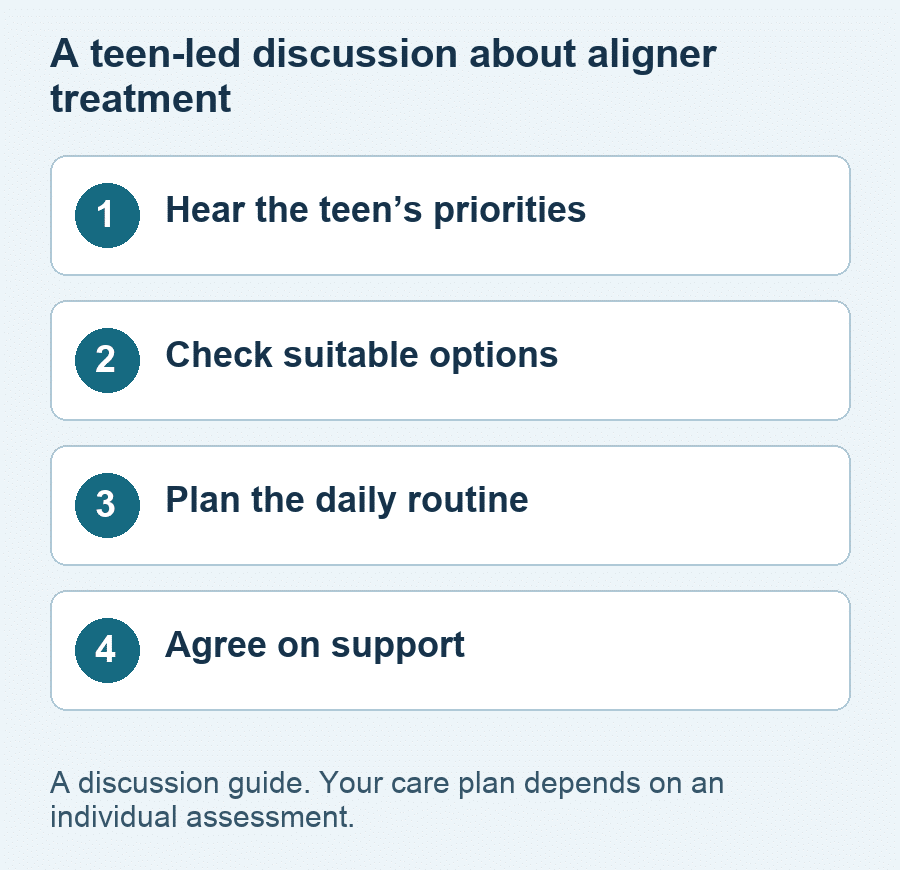
- Hear the teen’s priorities. Keep the discussion free of appearance shaming or promises about popularity.
- Understand the diagnosis. Ask which alignment and bite findings treatment aims to address.
- Compare suitable options. Review benefits, limitations and daily responsibilities for each.
- Practise the routine on paper. Plan meals, cleaning, wear, storage and contact arrangements.
- Agree on support and review. Decide how to discuss difficulties and when to ask the practice for help.
Keep oral health and retention in the plan
Teeth and trays need cleaning, and routine dental checkups continue. Aligners should not be treated as a shield against decay or gum disease. Ask which cleaning method suits the appliance and how a school-day routine can work safely.
After active treatment, retainers help limit unwanted movement. Discuss the ongoing schedule, replacement arrangements and cost before comparing complete treatment estimates. A projected finish date should not make long-term care disappear from the conversation.
Review Smiles by Design’s Pascagoula Invisalign information and use the consultation page to ask about an individualized assessment and the actual appointment location.
Frequently asked questions
Will Invisalign make my teenager more confident?
It may suit a preference for a less noticeable appliance, but confidence or mental-health improvement cannot be guaranteed. Listen to the teen’s concerns and keep expectations realistic.
Are the trays completely invisible?
No. Trays and any required attachments or elastics can be visible. Ask what the proposed plan actually includes.
Can trays be left out for a whole school event?
Follow the treating clinician’s instructions. Do not assume a special event changes the prescribed daily wear requirement.
What if my teen prefers braces?
That preference deserves discussion alongside clinical suitability, care responsibilities and cost. Clear aligners are not automatically the best choice for every teenager.
What if the wear routine becomes difficult?
Contact the team early to discuss barriers and appropriate next steps. Do not improvise tray changes or try to compensate without guidance.