
Braces add places where food and plaque can collect. A quick pass across the front of the teeth may miss the edges of brackets, the gumline and spaces beneath the wire. A useful cleaning routine focuses on those areas without relying on harsh scrubbing or a complicated collection of gadgets.
For patients wearing braces near Ocean Springs, the best tools are ones you can use correctly and consistently. Ask your orthodontist and dentist to demonstrate a routine for your appliance. This guide explains the purpose of common tools, a manageable daily sequence and changes that deserve professional advice.
Understand what you are trying to remove
Plaque is a film of bacteria that builds up on teeth. The National Institute of Dental and Craniofacial Research’s gum-disease information explains why plaque control and professional care matter for gum health. Braces do not cause every dental problem, but brackets and wires can make cleaning more demanding.
The target is the whole tooth surface and gumline, including the areas around the appliance. Brushing forcefully does not compensate for missing a surface. Ask the team to show the angle and motion that work for your bracket arrangement.
White marks around brackets, persistent bleeding or swollen gums should not be dismissed as inevitable. A clinician can assess the cause and review your technique and dental care needs.
Give each tool a clear job
| Tool | What it can help with | What to clarify |
|---|---|---|
| Soft toothbrush, manual or powered | Cleaning tooth surfaces and around the gumline and brackets | Brush size, technique and access to difficult areas |
| Fluoride toothpaste | Supporting routine decay prevention | A suitable product and amount for the patient’s age and needs |
| Floss with a suitable threader or an orthodontic floss aid | Cleaning between teeth where the wire makes access difficult | How to guide it without damaging the appliance or gums |
| An interdental brush | Reaching appropriate spaces around components or between teeth | The right size, location and gentle technique |
| Water flosser | An additional option for cleaning support in suitable patients | Its role in your plan rather than assuming it replaces every other method |
| Mirror and good lighting | Checking what was missed | Which areas are commonly overlooked in your mouth |
The Canadian Association of Orthodontists’ oral-hygiene guidance is another useful overview. Your dental team should tailor the routine to your appliance, dexterity, age and oral-health findings.
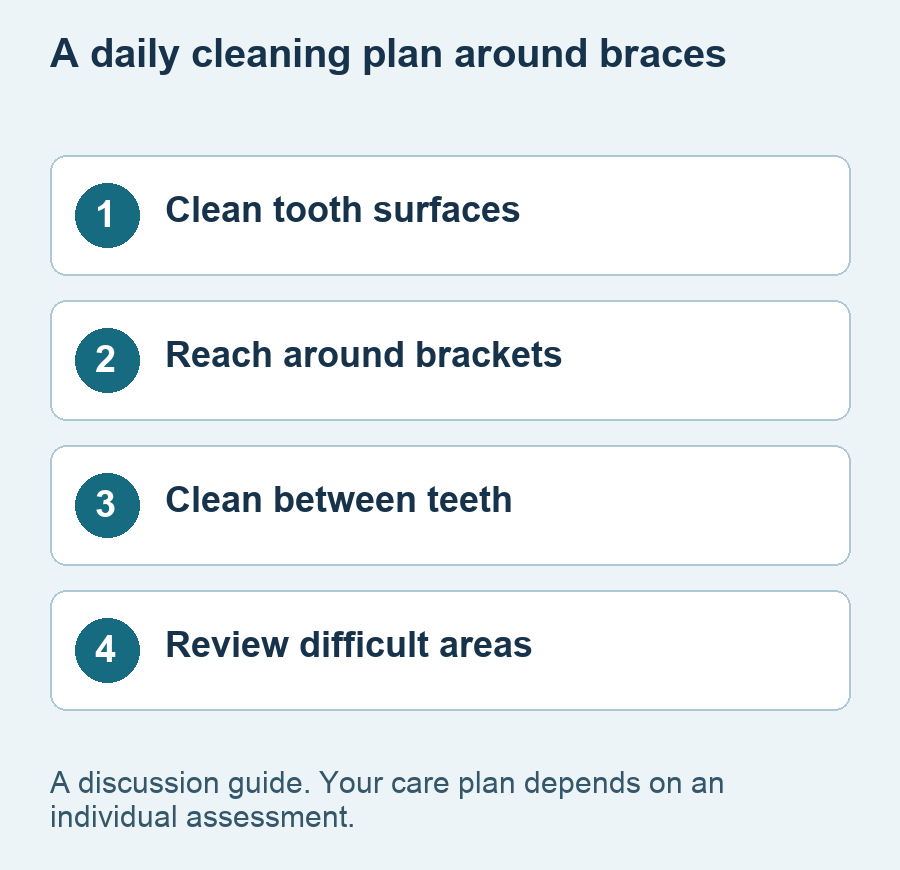
A six-step evening routine
- Get the recommended tools ready. Work where you can see the teeth and appliance clearly.
- Clean the tooth surfaces systematically. Follow the demonstrated brushing technique, including the inside surfaces and chewing surfaces.
- Pay attention around brackets and the gumline. Approach the areas the team has identified rather than scrubbing only over the wire.
- Clean between teeth. Use the appropriate floss aid or interdental method as instructed, with gentle control.
- Check the result in the mirror. Look for food left near brackets and areas you routinely miss.
- Follow the team’s final instructions. Ask about toothpaste use, any prescribed products and what to do if an area remains difficult.
The exact order of brushing and interdental cleaning can follow your clinician’s advice. What matters is that both are completed effectively and regularly.
Make the morning and school-day routine realistic
Build brushing into a consistent morning routine. For school, work or travel, keep a compact kit with the tools your team recommends. Ask how to handle cleaning after meals when a full bathroom routine is difficult.
Rinsing away loose food can be helpful in the moment, but it is not a substitute for thorough brushing and cleaning between teeth. Do not let a convenient daytime measure replace the more complete routine at home.
For children, a parent or caregiver may need to supervise or assist. Ask for a demonstration that both the child and caregiver understand. A task chart can help with consistency, but the team still needs to check that the technique is effective.
Food choices affect cleaning too
Follow the practice’s food precautions to protect brackets and wires. Sticky food can be difficult to remove, while hard food may damage components. Cut firm foods or use a suitable preparation method where advised.
Frequent sugary snacks and drinks create additional challenges for decay prevention. Discuss a pattern of meals, snacks and drinks that fits your health needs. Do not assume that a mouthwash or powered brush can cancel out every dietary exposure.
If food seems permanently trapped around a damaged component, contact the practice. Do not use sharp household objects to reach beneath the wire.
What to do about bleeding or sore gums
Gums that bleed repeatedly, appear swollen or make cleaning difficult need assessment. Plaque-related inflammation is one possibility, but an article cannot establish the cause. Tell the dentist or orthodontic team what you notice and how long it has been happening.
Do not abandon all cleaning because of bleeding. Ask for a gentle appropriate technique and a review of the affected area. Persistent pain, swelling or a new ulcer also deserves advice.
Avoid abrasive whitening powders, household acids and other home remedies around braces. These do not replace plaque removal and may be unsuitable for the teeth, gums or appliance. Discuss whitening questions separately with your dentist.
Regular dental care remains essential
Orthodontic visits focus on tooth movement and appliance care. They do not replace routine dental examinations, professional cleaning or treatment of decay and gum disease. Ask both teams how often you should be reviewed based on your own needs.
Smiles by Design’s life-with-braces information and braces page provide a starting point for questions. Bring your actual tools to a visit if you want the team to check how you use them.
A routine becomes more useful when it is reviewed and adjusted. Tell the team about areas you cannot reach, a tool you cannot manage or a schedule that keeps failing so the plan can be made workable.
Frequently asked questions
Is a powered toothbrush required for braces?
Not universally. Effective technique and consistent use matter. Ask which brush and approach fit your needs and appliance.
Can a water flosser replace all other cleaning?
Do not assume so. Ask the dental team how it fits your routine and which interdental cleaning method is appropriate for you.
Should I stop flossing if my gums bleed?
Persistent bleeding needs assessment and a technique review. Ask for guidance rather than abandoning cleaning or forcing a painful method.
Can mouthwash replace brushing after meals?
No. Rinsing does not replace thorough brushing and cleaning between teeth. Use any additional product as advised.
Do I still need my regular dentist during braces?
Yes. Routine examinations, professional cleaning and treatment of dental disease continue during orthodontic treatment.